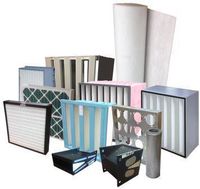
Replacement filters for every air filtration system
Each filter has its own filter class that indicates how well the filter can provide protection. Higher filter classes offer better protection, but cannot be applied in all systems. Our technical advisors are happy to help you make the right choice.
AXO Filtertechniek has a large assortment of heat recovery ventilation filters, bag filters, panel filters, filter cloths, filter mats and activated carbon filters. We can also have your filters custom-made. If you would like personal advice or would like more information, please feel free to contact us.
Filter classes and European standards
ISO 16890 replaces the outdated EN 779 standard
The ISO 16890 standard has replaced the previous EN 779 standard for testing and classifying air filters. The main difference lies in the way filter performance is assessed:
EN 779 focused solely on the filtration efficiency of a single specific particle size (0.4 μm), whereas ISO 16890 classifies filters based on their efficiency in removing different particle sizes (PM1, PM2.5 and PM10). This provides a more realistic picture of performance in real-world situations.
EN 779 (obsolete standard):
- Classified filters into G- (coarse) and F- (fine) categories, solely based on their ability to capture 0.4 μm particles.
- Used a single particle size for the test, which was not always representative of the actual distribution of particles in the air.
- Has since been withdrawn and replaced by ISO 16890.
ISO 16890 (current standaard):
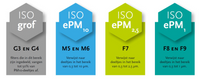
- Divides filters into four categories: ISO Coarse, ISO ePM10, ISO ePM2.5 and ISO ePM1.
- Measures the efficiency of removing particles of different sizes: PM10 (≤10 μm), PM2.5 (≤2.5 μm) and PM1 (≤1 μm).
- The ePM value indicates the percentage of particles of a certain size that is captured (for example, ePM1 70% means that the filter captures more than 70% of PM1 particles).
- Provides a more realistic picture of filter performance because it takes multiple particle sizes into account that are relevant to air quality.
- Is globally recognized as the current standard for testing and classifying air filters.
- Uses a more extensive test procedure, including measurements both in the original state and after neutralizing the electrostatic charge.
There are situations where extremely high requirements are placed on air quality. For example in operating rooms, cleanrooms or laboratories. In January 2011, the NEN EN1822 standard was published for this purpose. This standard describes the testing of the filtration properties of absolute filters and is classified into the groups EPA (Efficient Particulate Air filter), HEPA (High Efficiency Particulate Air filter), and ULPA (Ultra Low Penetration Air filter).


 EN
EN NL
NL